Ductless Mini Split Utah County Installation
Ductless Mini Split Utah County Installation
Central HVAC is a great system for a lot of homes and scenarios. But there are situations where running ductwork isn’t practical, isn’t cost-effective, or simply isn’t possible, and those situations come up frequently in Utah County homes. A finished basement with no duct access. A detached garage that needs heat through the winter. An addition where tying into the existing system would require tearing into finished walls. A bonus room above the garage that the central system never reaches. An ADU without access to the main living unit’s duct work.
In those situations, a ductless mini split Utah County is not a compromise. It’s a more efficient, more targeted solution than trying to force a central system to do something it wasn’t designed to do.
Peak Air HVAC designs and installs ductless mini split Utah County systems. Our technicians are NATE, EPA, and RMGA-certified with over 10 years of HVAC experience. We install systems from Carrier, Bryant, Goodman, Amana, and Lennox, back every installation with a 2-year labor warranty and 10-year parts warranty, and offer financing up to 18 months no interest for qualified customers.
Call 801-367-9007 to schedule a ductless mini split Utah County consultation.
When a Mini Split Makes More Sense Than Extending Ductwork
Basement finishes. Finishing a basement is one of the most common home projects in Utah County. The question of how to heat and cool the space always comes up. Extending the existing duct system works in some homes and creates problems in others: undersized equipment, unbalanced airflow, and comfort issues on both floors. A ductless mini split Utah County handles the basement as its own zone, independently from the rest of the house, without loading the central system with a space it wasn’t sized for.
Garages. A heated garage in Utah County is useful several months out of the year. Connecting a garage to the central system isn’t practical or code-compliant in most cases. A single-zone mini split handles heating and cooling in a garage cleanly and efficiently, with no ductwork required.
Additions and remodels. Adding a room or converting a space often means there’s no clean path to extend ductwork. Cutting into finished walls, running new lines through attic space, or resizing the air handler are all expensive and disruptive. A mini split serves the addition independently without touching the rest of the system.
Older homes without ductwork. Some of the older homes in Provo, Orem, and central Utah County were originally heated with boilers or radiant systems that never had forced air. Adding a full ducted system to an older home is a significant project. Mini splits can provide both heating and cooling in targeted areas of the home without any ductwork at all.
Accessory dwelling units (ADUs). A ductless mini split Utah County is one of the best HVAC options for an ADU. Connecting a detached or attached ADU to the main home’s duct system usually isn’t practical, and running new ductwork for a small separate space is expensive. A single-zone mini split needs only a small penetration through the wall for the line set, keeps the ADU’s heating and cooling independent from the main home, and handles both functions in one unit. For rental ADUs, independent temperature control and separate energy usage are practical advantages beyond just comfort. One consideration for northern Utah County: if the ADU needs to stay habitable through January and February at higher elevations, a cold-climate rated unit is worth specifying over a standard mini split to maintain heating output when outdoor temperatures drop.
Problem rooms in otherwise comfortable homes. If one room in your house is always too hot in summer or too cold in winter regardless of what the thermostat is set to, a mini split for that room is often a more effective fix than rebalancing the whole duct system.
How Mini Split Systems Work
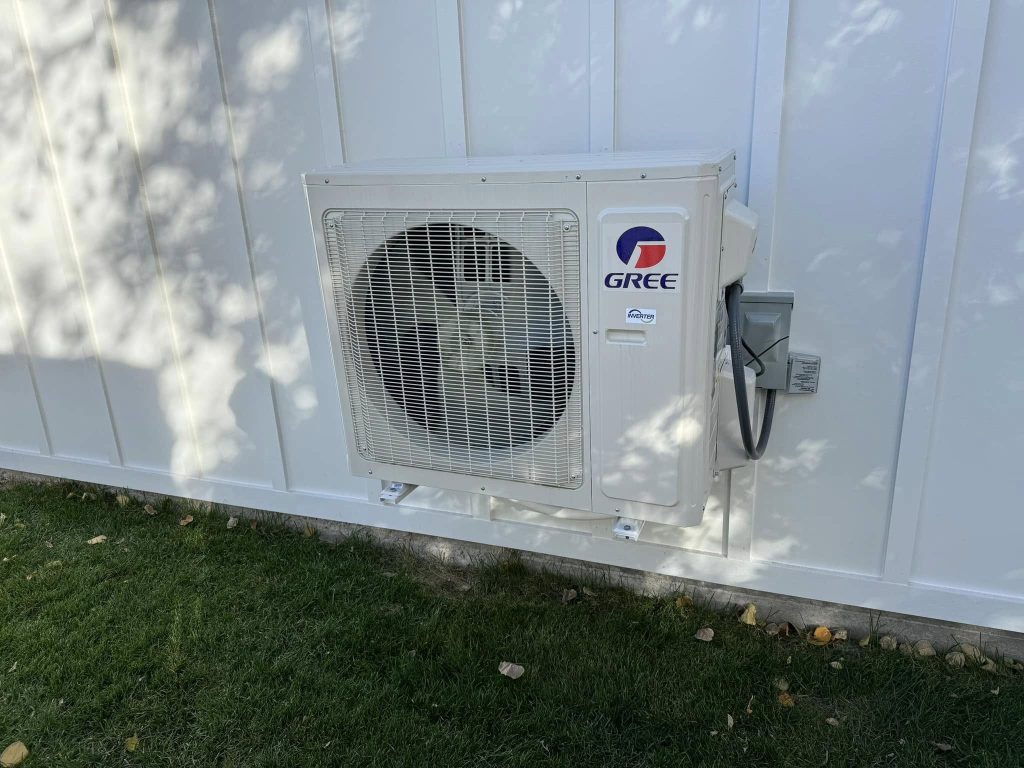
A ductless mini split Utah County system has two components: an outdoor condenser unit and one or more indoor air handlers mounted on the wall, ceiling, or floor of the space being conditioned. Refrigerant lines connect them through a small hole in the wall, no ductwork involved.
Most mini split systems are heat pumps, meaning they provide both heating and cooling from the same equipment. In heating mode, the system extracts heat from outdoor air and transfers it inside. In cooling mode, that process reverses.
One outdoor unit can support a single indoor head (single-zone) or multiple indoor heads in different rooms (multi-zone), each controlled independently. Multi-zone setups are common for larger additions, multiple basement rooms, or homes where several spaces need independent temperature control.
Mini Splits in Utah County's Climate
Utah County winters get cold. A standard mini split loses efficiency and heating capacity as outdoor temperatures drop, which matters here. Cold-climate rated systems, designed to operate at lower ambient temperatures than standard units, are often the right choice for ductless mini split Utah County installations where the mini split will be doing meaningful heating work through January and February.
We evaluate which system tier makes sense for each application. A mini split serving a garage that doesn’t need to maintain comfortable living temperatures has different requirements than one heating a finished basement bedroom. Getting that selection right is part of the installation process, not an afterthought.
Central duct systems also lose approximately 20 to 30% of their efficiency through duct leakage and heat transfer in unconditioned spaces like attics and crawlspaces. Mini splits deliver conditioned air directly into the space being heated or cooled, with no duct losses. In spaces where the central system would have to work through a long duct run anyway, a mini split is often the more efficient option.
Our Mini Split Installation Process
Every ductless mini split Utah County installation starts with a load calculation for the space being served. The most common mistake in mini split installation is selecting equipment based on square footage alone without accounting for insulation, ceiling height, window area, and how the space is used. An oversized unit short-cycles and creates humidity problems. An undersized one runs constantly and can’t keep up on extreme weather days.
From there we handle equipment selection, mounting location for the indoor head, line set routing, electrical connections, refrigerant charging, and commissioning. Most single-zone jobs are completed in a single day.
Mini Split Services
Installation and Replacement
New mini split installations for basements, garages, additions, and problem spaces throughout Utah County. We size the system to the space and install it to perform.
Repair
Ductless mini split Utah County repairs including refrigerant leaks, error codes, drainage problems, fan motor failure, and communication issues between indoor and outdoor units.
Maintenance
Annual maintenance for mini split systems covers coil cleaning, filter inspection, refrigerant pressure check, drain line clearing, and electrical connections. Ductless mini split Utah County systems require less maintenance than ducted systems but are not maintenance-free.
Frequently Asked Questions
Are mini splits a good option for Utah County homes?
Yes, when they’re applied to the right situations. Basements, garages, additions, ADUs and spaces without ductwork are where mini splits consistently outperform trying to extend a central system. For whole-home primary heating and cooling in a home that already has ductwork, a central system is usually the better fit.
Do mini splits provide heat in Utah County winters?
Yes. Most ductless mini split Utah County systems are heat pumps that provide both heating and cooling. For Utah County installations where the unit will see real winter temperatures, we specify cold-climate rated systems designed to maintain output at lower ambient temperatures than standard units.
How many indoor units can one mini split system support?
Depending on the outdoor unit capacity and configuration, one outdoor unit can support multiple indoor heads – typically two to five, depending on the system. Each indoor head operates independently with its own temperature control.
Is a mini split better than extending ductwork for a basement or addition?
In many cases, yes. Extending ductwork is expensive, disruptive, and often requires resizing the central air handler if the existing system wasn’t sized with additional space in mind. A mini split serves the new space independently without affecting the rest of the system. We’ll tell you honestly which approach makes more sense for your specific situation.
Is a mini split a good option for an ADU?
Yes. A mini split is one of the most practical HVAC solutions for an accessory dwelling unit. It requires no ductwork, keeps the ADU’s heating and cooling independent from the main home, and handles both heating and cooling in one system. For rental ADUs, the independent controls and energy usage are practical advantages beyond comfort. If the ADU is in northern Utah County at higher elevation, we’d specify a cold-climate rated unit to maintain heating output through January and February.
How much does mini split installation cost in Utah County?
Cost varies based on system capacity, number of indoor heads, line set length, and electrical requirements. We provide a written estimate before any work starts. Financing up to 18 months no interest is available for qualified customers.
Serving Utah County
- Santaquin
- Spanish Fork
- Springville
- Mapleton
- Payson
- Provo